Restaurant Inventory Counts: Why Weekly Beats Monthly
Most restaurants count inventory once a month, and usually only because someone needs a number for the books. By then the month is over, the food is gone, and whatever was quietly draining cash has already done its damage. You cannot fix a leak you only find thirty days after it started.
Weekly counts are the fix. They take less time than most owners expect, they turn your food cost from a guess into a number you can trust, and they catch small problems before they compound into a bad month. Here is why the cadence matters more than almost anything else on your shelf.
A monthly count is an autopsy, not a checkup
One count every thirty days gives you a single data point. It is enough to calculate a food cost percentage and hand it to your bookkeeper. It is not enough to run a kitchen.
A monthly number blends a good week, a bad week, and two forgettable ones into one average. When that average comes back high, you have no way to know which week broke, which item walked out the back door, or which vendor raised prices without telling you. The trail is already cold. You are performing an autopsy on a month you can no longer change.
What weekly counts catch that monthly counts miss
Counting every week shrinks the gap between a problem starting and you seeing it from thirty days down to seven. That is the whole game. A few things that only show up at a weekly cadence:
- Portion creep. A cook who starts plating six ounces instead of four will not show up on a monthly P&L until it has cost you for weeks. On a weekly count, the protein usage jumps the same week it starts.
- Theft and shrinkage. Product leaving without a matching sale is far easier to spot when you are comparing tight weekly numbers than a fuzzy monthly average.
- Quiet price increases. Vendors raise prices and rarely send a memo. A weekly count next to your invoices makes the jump obvious while you can still call, push back, or switch suppliers.
- Spoilage and over-ordering. If produce is hitting the trash every week, weekly counts make the pattern impossible to ignore and tell you exactly how much to trim from the next order.
The math you are actually after
The point of counting is to calculate your cost of goods sold. The formula is not complicated:
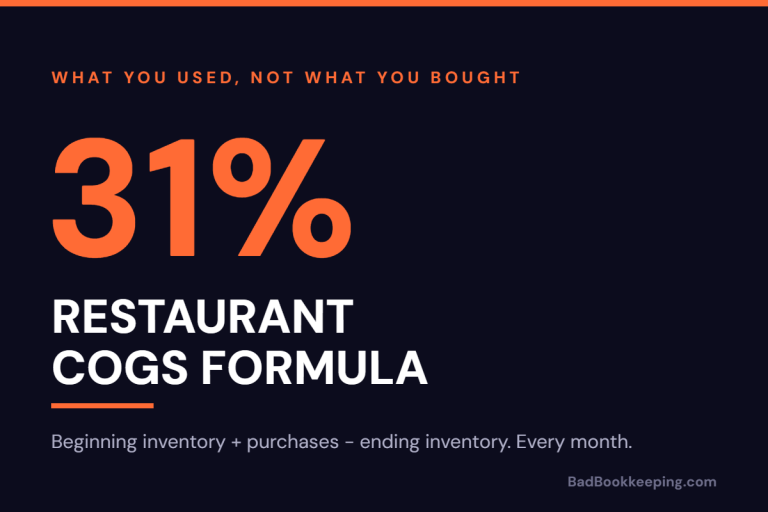
Beginning Inventory + Purchases – Ending Inventory = COGS
Then divide COGS by sales for the same period to get your food cost percentage:
COGS / Food Sales = Food Cost %
Run that weekly and you get four or five real readings a month instead of one. You can catch food cost trending up in week two and react, instead of finding out in week five that the whole month was underwater. Most full-service restaurants aim for food cost somewhere in the high twenties to low thirties as a share of sales, but the exact target matters less than watching your own number move week over week.
How to run a weekly count in under an hour
Owners avoid weekly counts because they remember inventory taking half a day. It does not have to. The trick is consistency, not speed.
- Same day, same time, every week. Pick a slow morning before a delivery, and hit the same point in your week every time so you are always comparing like for like. Most kitchens land on a Sunday or Monday before the first order arrives.
- Count sheet in shelf order. Build the sheet to match the physical walk through your walk-in, freezer, and dry storage. When the sheet matches the shelves, you stop backtracking and the count flies.
- Two people: one counts, one writes. It is faster and a lot harder to fudge. One person calls the number, the other records it.
- Pick one unit and stick to it. Count a case as a case every week, or break everything down to the each. Switching units between counts is the fastest way to produce a garbage number.
- Estimate open containers the same way every time. Half a bag is half a bag. The goal is a consistent method, not laboratory precision.
The mistakes that make a count worthless
A sloppy count is worse than no count, because it hands you a number you trust and should not. The usual offenders:
- Counting when there is time instead of on a fixed schedule, so your periods are never the same length.
- Changing units between counts: cases one week, pounds the next.
- A different person counting every week with no agreed method.
- Counting after a delivery one week and before it the next.
- Nobody actually owning the number, so it gets rushed or skipped entirely.
Fix those and your weekly count becomes the most reliable management tool in the building.
What it unlocks
Once weekly counts are a habit, the payoff stacks up. You get a real, current food cost instead of a month-old guess. You get the front half of prime cost under control, which is the single biggest lever on restaurant profit. You get leverage with vendors because you can prove exactly when their prices moved. And you catch the small leaks, the over-portioning and the spoilage and the product walking out the door, while they are still small.
None of that comes from counting harder. It comes from counting more often, and writing it down the same way every single time.
Behind on your restaurant books?
Food cost, prime cost, POS reconciliation, mixed beverage tax. If your numbers are a mess or you are months behind, we clean it up and keep it clean.
Book a Free Call