Texas Mixed Beverage Tax: What Restaurants and Bars Actually Owe
Texas mixed beverage tax looks simple from across the bar: two rates, one due date, done. Then you add a cocktail program, cater a wedding, start selling margaritas to go, or comp the regulars, and suddenly nobody in the building can say which tax applies to what. The state has a pretty good idea, though. Every distributor that sells you alcohol tells the Comptroller how much it sold you, every month.
We covered the booking basics, two taxes in two different accounts, in bar and brewery bookkeeping. This post goes deeper: who actually owes the tax, what it covers besides the drink, how tax-included pricing goes wrong, what the monthly filing looks like, and how the state checks your math. Everything below reflects Texas Comptroller guidance as of October 2026.
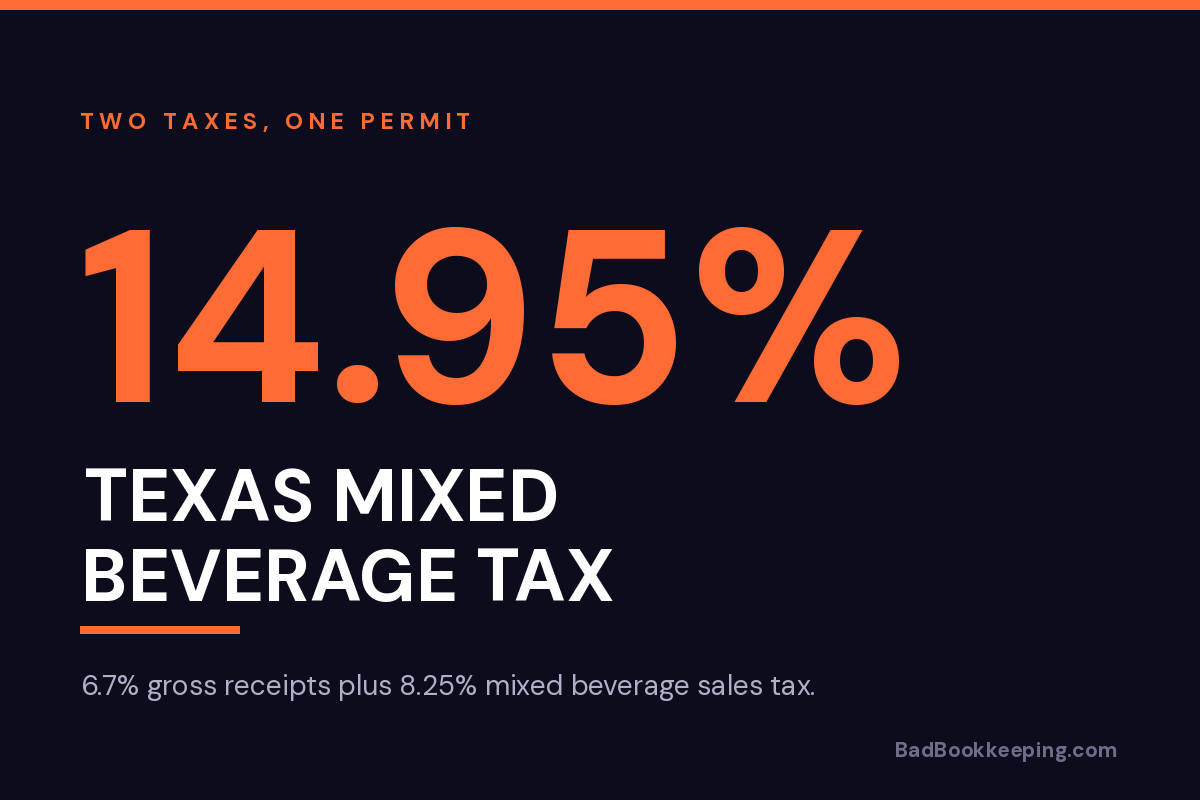
The short version: two taxes, 14.95% combined
If you hold a TABC mixed beverage permit, every alcohol sale for on-premises consumption carries two taxes:
- Mixed beverage sales tax, 8.25%. The customer's tax. You collect it, hold it and send it to the Comptroller. It is a flat statewide rate that replaces regular state and local sales tax on the drink, so there is no city add-on.
- Mixed beverage gross receipts tax, 6.7%. Your tax, on what you take in. You cannot add it to the check, and nobody is exempt from it, not even nonprofits.
Together, that is 14.95 cents to the state on every dollar of drink price. One of those taxes passes through you. The other is a cost, and it comes straight out of margin.
Who owes Texas mixed beverage tax: the permit decides, not the drink
The tax follows your TABC permit. For mixed beverage tax purposes, the Comptroller treats you as a permittee if you hold any of these:
- A mixed beverage permit, with or without a food and beverage certificate or a retailer late hours certificate
- A private club registration permit or a private club exemption certificate
- A nonprofit entity temporary event permit
- A distiller's and rectifier's permit (yes, the tasting room counts)
If your only permit is a wine and malt beverage retailer's permit, the one TABC lists as BG, you are not a permittee. Your beer and wine sales take regular state and local sales tax, and the 6.7% never applies.
The beer and wine trap
Once you hold a mixed beverage permit, every alcoholic beverage you sell for on-premises consumption is a "mixed beverage" for tax purposes, including the draft beer and the house red. The Comptroller's own mixed beverage tax FAQ is blunt about it: a restaurant with a mixed beverage permit owes both taxes on beer and wine, even at an off-site catering job that pours nothing else. A brewpub that also holds a mixed beverage permit owes both taxes on its own beer in the taproom.
This bites hardest the month you upgrade. Say a Plano restaurant sells $30,000 a month of beer and wine on a BG permit, then moves up to a mixed beverage permit to add cocktails. The customer's rate does not change in Plano: 8.25% either way. But the 6.7% now lands on all $30,000 of beer and wine it was already selling. That is $2,010 a month, $24,120 a year, before the first margarita. Put that number in the cocktail program's business case.
The certificates ride along
A late hours certificate or a food and beverage certificate does not change the tax math. The food and beverage certificate does put your books on the hook, though. Some local-option areas only allow mixed drinks in restaurants that hold one. To get it you need a permanent kitchen and multiple entrees, plus one of two things: alcohol at 60% or less of the location's total receipts, or your own kitchen with commercial cooking equipment, which is how TABC defines a restaurant. If you lean on the 60% test, comps count toward the alcohol side at their dollar value, and TABC can ask for records that split alcohol, food and everything else. Your POS categories are a permit condition, not just a nicer P&L.
What the tax covers besides the drink
The tax base is wider than the bar menu. These are in it:
- Ice and mixers sold to go into a drink. If the soda in a rum and Coke rings up as its own $2 line, that $2 is still a mixed beverage sale. Coffee on its own takes regular sales tax. Add a shot of Irish cream and the whole drink is a mixed beverage.
- Bartender and server fees. If you staff a private event and pour, the labor charge takes both mixed beverage taxes, even when the customer supplies the alcohol.
- Some mandatory gratuities. An auto-gratuity on alcohol stays out of the tax only if it is 20% or less, labeled as a tip or service charge, and paid out to the people who served it: servers, bussers, bartenders, wine stewards. Any part the house keeps, or pays to chefs, dishwashers or owners, is taxable. Go over 20% and the whole charge is taxable. If your tip pool lives in a group chat, start with tip pool accounting.
These are not:
- To-go, pickup and delivery alcohol. It is not consumed on your premises, so mixed beverage taxes do not apply. It takes regular state and local sales tax and goes on your regular sales tax return.
- Cover charges. Regular sales tax, unless TABC decides the charge breaks its rules.
- Comps. A comped drink brings in no receipts, so it owes no gross receipts tax. Comps still go on the gross receipts return at menu price, for information only, and you owe use tax on the cost of the ingredients on your regular sales tax return. Almost nobody does that second part.
- Spills, breakage and alcohol used in the kitchen. No gross receipts tax, if you can prove it. Hold that thought.
Add it up and one POS feeds three tax returns. On-premises alcohol goes on the two mixed beverage reports. Food, to-go alcohol, cover charges and the use tax on comps go on the regular sales tax return. If your POS cannot split on-premises alcohol from to-go alcohol, neither can your returns.
Tax-included pricing: allowed, with a catch
Texas lets you handle the 8.25% two ways: add it to the check, or build it into the menu price. You have to pick one method, and the Comptroller says you cannot alternate between them. The 6.7% is never added to the check either way.
The catch is Comptroller Rule 3.1002: the total on a receipt is presumed to be the price before tax. If you price tax-included, your records have to prove it. The simplest proof is a line on every receipt. The Comptroller's own sample reads "Sales and MB Sales taxes are included in sales price." Put it on the menu too.
Here is what failing to prove it costs on $64,950 of tax-included alcohol sales in one month:
- Documented as tax-included: $64,950 / 1.0825 = $60,000 of taxable sales. Mixed beverage sales tax $4,950, gross receipts tax $4,020. Total $8,970.
- Presumed tax-excluded: mixed beverage sales tax of 8.25% x $64,950 = $5,358.38, plus gross receipts tax of 6.7% x $64,950 = $4,351.65. Total $9,710.03.
That is $740.03 a month, $8,880.36 a year, for one missing line on a receipt.
The other way to get this wrong is printing the 6.7% on the check as a "tax." You cannot pass it to the customer, and anything a receipt calls a tax is owed to the state in full, on top of the 6.7% you already owe. You are allowed an informational line telling the guest what you pay in gross receipts tax on their order, as long as it is not part of what they pay.
Filing: two returns a month, due the 20th, even when you sold nothing
Texas mixed beverage tax is filed monthly. There is no quarterly or annual option, and no timely filing discount like the one on regular sales tax.
- Form 67-100, the gross receipts tax report, with a 67-101 supplement for each location. Liquor, wine and beer are reported separately, and ice and mixers go in with liquor.
- Form 67-103, the mixed beverage sales tax report, with a 67-104 supplement for each location.
- Both are due on or before the 20th of the following month, so September's drinks are due October 20. A weekend or holiday pushes it to the next business day. Both can be filed and paid in Webfile.
- A zero month still needs both returns. Closed for a remodel in August? File anyway.
Late gets expensive quickly: a $50 penalty for every late report, even when no tax was due; 5% of the tax if you pay 1 to 30 days late and 10% after that; interest starting on day 61. Skip a return entirely and the Comptroller estimates what you owe, then adds another 10% if you do not file or pay within 20 days.
Two more things surprise owners. The Comptroller holds two security bonds, one for each tax, each between $3,750 and $100,000 for a mixed beverage permit, or four times your average monthly tax if that is greater. That is on top of TABC's own conduct bond. And a new TABC permit application needs the Comptroller's signature, which it will not give while the applicant or its owners are delinquent on state taxes. A sloppy first location can hold up the second one.
Audit exposure: Texas already knows what you bought
A Texas mixed beverage tax audit does not start with your POS. It starts with your suppliers.
- Your distributors report you. Every wholesaler, distributor, manufacturer and brewer that sells to retailers files a monthly report with the Comptroller showing what it sold to each retail location, by permit number. The audit rules let the auditor compute your tax from information supplied by anyone who sold you alcohol.
- Your numbers are public. The Comptroller publishes every permittee's monthly mixed beverage gross receipts by location, split into liquor, wine, beer and cover charges. Dallas County permit holders alone reported about $130 million of alcohol sales in June 2026, every location listed by name and address. Competitors, landlords and buyers can look you up. So can auditors.
- The method is a depletion audit. The auditor takes what you bought, adjusts for inventory, converts it into drinks, prices those drinks off your menu and compares the total to what you reported. Without records to the contrary, the rules let the auditor assume 1.25 ounces per liquor pour, 16 ounces per beer and 6 ounces per glass of wine.
- The gap gets taxed at both rates. That is 14.95% combined, plus penalty and interest, and you cannot go back and collect the 8.25% from last year's customers. The normal lookback is four years. It runs longer if a return was never filed, was fraudulent, or understated the tax by 25% or more.
Here is where this ties back to pour cost. A comp nobody rang in, a spill nobody logged, a bartender with a heavy hand: none of those is a sale. In a depletion audit, though, a drink you cannot account for looks exactly like a drink you sold and did not report. The Comptroller has upheld assessments against a restaurant and bar that could not document its comps and waste, and against a nightclub that could not show its opening and closing inventory.
Worked example: one year of liquor at a Fort Worth sports bar
Here is roughly how the math runs. A real audit also covers beer and wine, uses pour tests and prices drink by drink. This is the shape, not the procedure.
Without records
- Distributor reports show 1,200 liters of spirits bought during the year
- A liter is 33.8 ounces, or about 27 pours at 1.25 ounces: 32,400 drinks
- Average liquor drink price before tax: $11.50, so computed liquor sales of $372,600
- Liquor sales reported on the year's 67-100 returns: $318,000
- Gap: $54,600
- Tax on the gap: $3,658.20 of gross receipts tax plus $4,504.50 of mixed beverage sales tax = $8,162.70 for the year, or $32,650.80 across a four-year audit, before penalty and interest
With records
- Month-end counts show 40 more liters on the shelf at year end than at the start: 1,160 liters used
- The waste log documents 25 liters of spills and breakage: 1,135 liters poured
- 1,135 liters at 27 pours each: 30,645 drinks
- The comp log documents 1,150 comped drinks: 29,495 drinks sold
- Computed liquor sales: 29,495 x $11.50 = $339,192.50, a gap of $21,192.50
- Tax on the gap: $1,419.90 plus $1,748.38 = $3,168.28 for the year, or $12,673.12 across four years
The records cut the exposure by about 61%. They do not erase it. The remaining $21,192.50 is about 1,843 drinks, roughly 35 a week, that left the bottle without landing on a ticket. That is the same leak as the pour cost gap in our bar bookkeeping example, and in Texas it is a tax problem as well as a margin problem.
How to set up the books so the returns write themselves
- POS categories that match the returns: on-premises liquor (with ice and mixers sold for drinks), wine and beer; to-go alcohol on its own; then food, nonalcoholic beverages and cover charges.
- Matching income accounts in QuickBooks Online, booked from the POS daily sales summary, not from the bank deposit.
- Two liability accounts: Mixed Beverage Sales Tax Payable and regular Sales Tax Payable. Never one account for both.
- A Mixed Beverage Gross Receipts Tax expense account, accrued every month to its own payable that clears on the 20th.
- A reason on every comp in the POS, and a waste log behind the bar, totaled monthly: comps at menu price for the 67-100, ingredient cost for the use tax on your sales tax return.
- Inventory counts at every month end, at minimum, kept with the purchase invoices for four years. Counts are what make the restaurant COGS formula work, and they are how you win the inventory adjustment in a depletion audit.
- A monthly reconciliation of both payables to the returns you filed. If your food and beverage certificate rests on the 60% test, check alcohol's share of total receipts, comps included, while you are there.
All of it slots into a normal monthly bookkeeping close checklist. For the rest of the Texas restaurant picture, including sales tax on food and tips, start with our DFW restaurant bookkeeping guide.
We are bookkeepers, not tax attorneys, and this is not tax or legal advice. What we can tell you is that plenty of bars that lose a mixed beverage audit were not cheating. They just could not prove they were not. If you would rather hand this off than build it yourself, here is what a bookkeeper actually costs.
Do your mixed beverage returns match your liquor invoices?
We set up bar and restaurant books that split every alcohol sale the way the returns need it, book both Texas mixed beverage taxes the right way, and keep the counts and comp logs an auditor asks for. The call is free and takes 15 minutes.
Book a Free Call