Bar and Brewery Bookkeeping: What Changes When You Pour
A bar is a restaurant where the inventory can walk out the door one ounce at a time, and nobody writes it down. Bar bookkeeping starts with everything that makes restaurant bookkeeping harder than most, then adds three problems a kitchen never has: inventory measured in ounces, a Texas tax that only alcohol pays, and, if you brew, a federal permit that turns you into a manufacturer.
Here is what changes when you pour, what it costs when the books get it wrong, and how to set them up so the numbers actually tie. The tax rules below are Texas rules, and the examples are from DFW.
What bar bookkeeping has that restaurant bookkeeping doesn’t
A restaurant’s worst cost problem is food that spoils. A bar’s is liquid that disappears: over-pours, comps nobody rings in, staff drinks, broken bottles, a keg that foamed half its volume down the drain. None of it shows up on an invoice. All of it shows up in your margin.
So bar books need four things a restaurant can sometimes get away without:
- Pour cost by category (spirits, draft, package beer, wine), not one blended COGS line.
- A weekly count. A monthly count hides a month of shrinkage. It is the same reason weekly inventory counts beat monthly in a kitchen, only the losses move faster.
- Two alcohol taxes booked two different ways. More on this below. It is the most common mistake we see on a bar’s P&L.
- Tip handling that ties POS to payroll. Bars run on tips. If that part is shaky, start with tip pool accounting.
Pour cost is the number that runs a bar
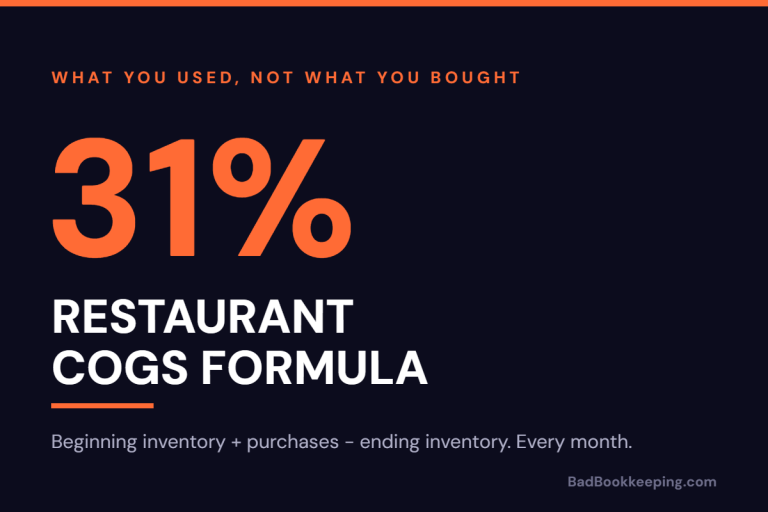
Pour cost is COGS for the bar: what you used, divided by what you sold. It is the same restaurant COGS formula a kitchen uses, run separately for each beverage category:
Pour cost = (Beginning inventory + Purchases – Ending inventory) / Beverage sales
That number is half the story. The other half is the gap between what you should have used, based on your recipes, and what you actually used.
Worked example: a Dallas cocktail bar, one week of spirits
The POS shows $16,800 in spirits sales. Every cocktail and pour on the menu has a recipe cost, and the menu is priced for an 18% pour cost. So the theoretical cost of what was sold is $16,800 x 18% = $3,024.
Now the actual count:
- Beginning spirits inventory: $6,450
- Purchases for the week: $3,210
- Ending spirits inventory: $5,880
- Spirits actually used: $6,450 + $3,210 – $5,880 = $3,780
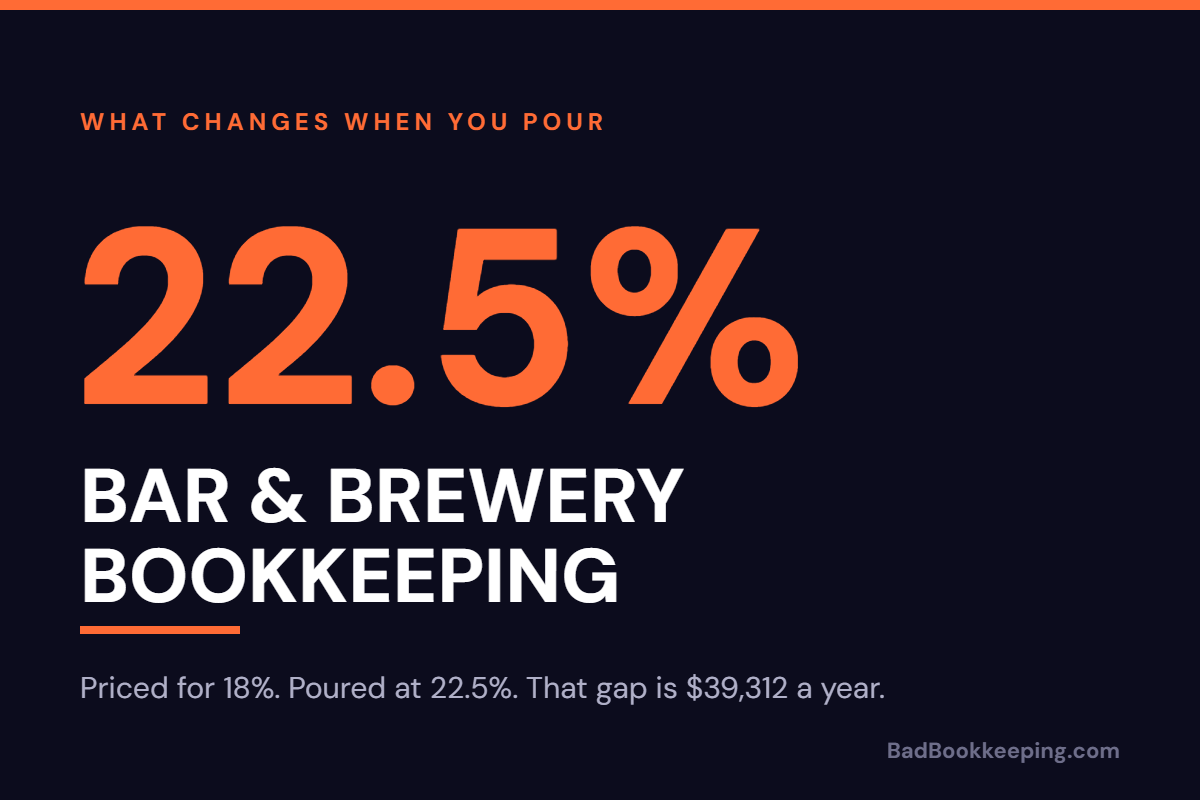
Actual pour cost is $3,780 / $16,800 = 22.5%. The gap between 18% and 22.5% is $756 in one week. Over a year that is $39,312 of liquor that left the bottle without ever landing on a ticket.
Without recipe costs and a weekly count, that $39,312 never shows up as a problem. It shows up as “margins were tight this year.”
Pour cost benchmarks by category
Targets depend on concept and pricing, but most bars land in these ranges:
- Spirits: 16% to 20%
- Draft beer: 20% to 25%
- Bottled and canned beer: 24% to 28%
- Wine: 28% to 35%
- Blended bar pour cost: 18% to 24%
A blended number can look fine while one category bleeds. That is why each category gets its own line in the chart of accounts, and why the bar belongs in your weekly prime cost review, not just the kitchen.
Texas mixed beverage tax: two taxes, booked two different ways
If you hold a TABC mixed beverage permit, every alcohol sale carries two separate taxes. They do not belong in the same account.
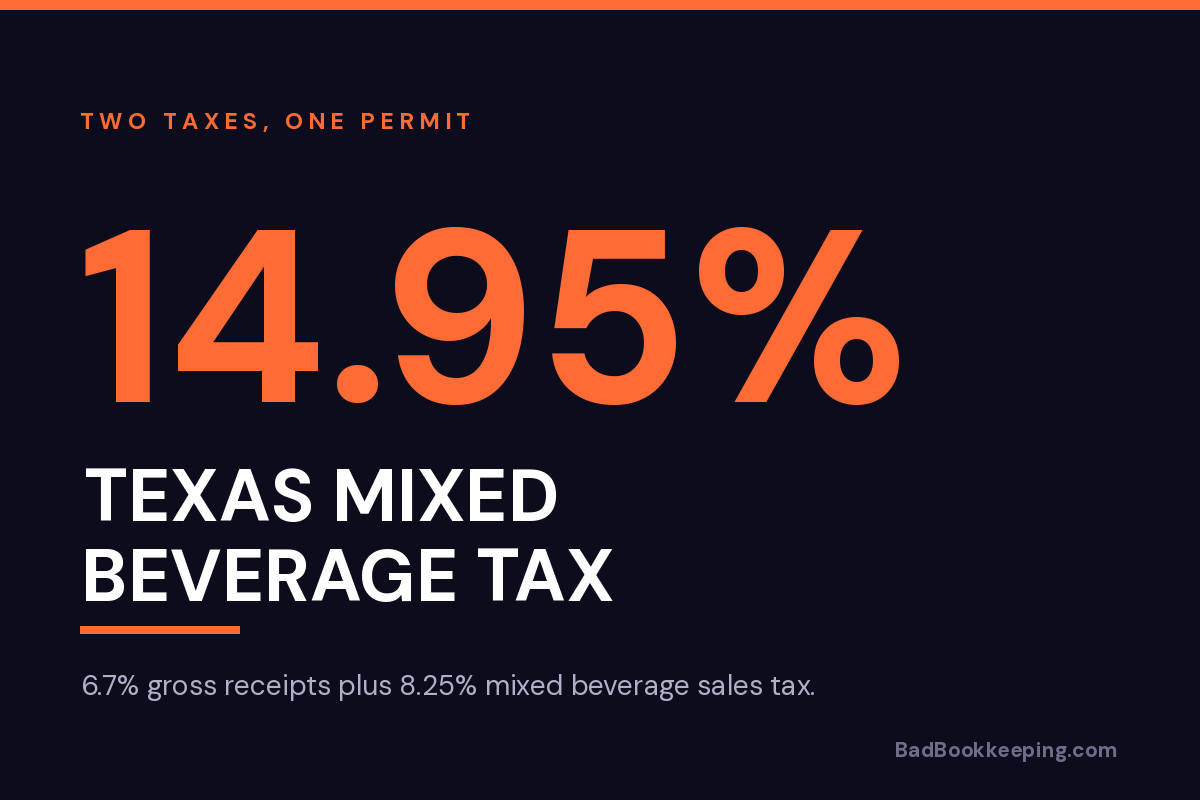
- Mixed beverage sales tax, 8.25%. Collected from the customer. It is a liability: it comes in, sits on the balance sheet, and goes out to the Comptroller. It never touches revenue.
- Mixed beverage gross receipts tax, 6.7%. Owed by you on your alcohol receipts, plus the ice and mixers sold to go with them. You cannot add it to the customer’s bill. It is an expense, and it comes straight out of margin.
Both are reported monthly, due by the 20th of the following month. (If you only hold a beer and wine permit, neither applies. You collect regular Texas sales tax on drinks instead.)
Here is where books go wrong. Plenty of bars price drinks with tax included, which Texas allows as long as you pick one method and stick with it. Take a $12 cocktail, tax included:
- Back out the 8.25% sales tax: $12.00 / 1.0825 = $11.09 of actual revenue
- Gross receipts tax on that revenue: $11.09 x 6.7% = $0.74
- What is left before the liquor cost: $10.34
If your bookkeeper records the full $12 as revenue and dumps both taxes into one sales tax payable account, revenue is overstated by 8.25% and the 6.7% expense vanishes into the balance sheet. The P&L says the bar is doing better than it is, and the liability account never reconciles to what you actually paid. For how this sits alongside regular sales tax and tips on the food side, see our DFW restaurant bookkeeping guide.
Breweries: congratulations, you are a manufacturer now
A brewery taproom has every bar problem above. Then the brewhouse stacks a second business on top: you make the product, and the government taxes it before you sell it.
Excise tax is due when beer leaves the bond, not when it sells
Federal beer excise tax is triggered when beer is removed from the brewery’s bonded premises, and pouring it in your own taproom counts. A domestic brewer making under 2 million barrels a year pays $3.50 a barrel on the first 60,000 barrels and $16 a barrel after that. Texas adds its own malt beverage tax of $6.00 a barrel on beer a brewery sells directly, reported to TABC monthly.
How often you file federally depends on how much you owe. If last year’s federal excise tax was $50,000 or less and you expect the same this year, you file quarterly, along with a quarterly Brewer’s Report of Operations. At $1,000 or less you can file annually. A 1,200-barrel brewery owes about $4,200 a year, so it is a quarterly filer.
The bookkeeping catch: the barrels on your TTB report, the barrels behind your excise expense and the barrels in your sales all have to tie. When they don’t, the culprit is almost always inventory.
Cost per barrel, and tanks full of inventory
Beer sitting in a fermenter on the last day of the month is not an expense. It is work-in-process inventory: the malt, hops, yeast and labor already in the tank are an asset until the beer is packaged and sold. Expense every grain delivery the day it arrives and your COGS swings with your brew schedule instead of your sales.
Brewery books should build a cost per barrel from:
- Raw materials: malt, hops, yeast, adjuncts
- Packaging: cans, labels, carriers (kegs are equipment, not packaging)
- Direct labor: brewhouse and cellar hours
- Overhead: utilities, CO2, cleaning chemicals, equipment depreciation
Know that number and you know whether a seasonal, a new account’s pricing or a canning run actually makes money.
Self-distribution adds a receivables business
Texas lets a brewer producing under 125,000 barrels a year self-distribute up to 40,000 barrels a year to retailers. Most small breweries start there, and it changes the books overnight: invoices, receivables from bars and stores, delivery costs and keg deposits. A keg deposit is a liability you owe back when the empty comes home, not revenue. Book deposits as sales and you inflate revenue and make your keg count impossible to reconcile.
If you also run a kitchen, give it its own P&L lines. A brewpub is a restaurant and a manufacturer under one roof, and blending the two hides which one is carrying the business.
The monthly close for bars and breweries
Everything in our monthly bookkeeping close checklist applies to bar bookkeeping too. Add these:
- Count liquor, beer and wine by category and compare actual pour cost to theoretical
- Reconcile mixed beverage sales tax payable to the return you filed
- Book the 6.7% gross receipts tax as an expense, not a liability that never clears
- Tie POS tips to payroll
- Breweries: tie barrels brewed, packaged, removed and sold to the TTB report and the excise expense
- Breweries: count tanks and value work-in-process at cost per barrel
- Breweries: reconcile keg deposits to kegs actually out in the market
None of it is hard. It just has to happen every month, because a bar with full seats and loose books is how an owner gets to December wondering where the money went.
Does your pour cost match your POS?
We set up bar and brewery books that track pour cost by category, book both Texas mixed beverage taxes the right way, and tie your barrels to your TTB reports. The call is free and takes 15 minutes.
Book a Free Call